
How to Eliminate Favoritism in Employee Recognition — A 5-Step Playbook
If you've ever sat in an HR meeting and watched a manager say "I'd like to nominate so-and-so for Employee of the Month again", and watched the other managers nod, and watched the room understand that the result was decided ten seconds before the meeting started — you've seen the favoritism problem. This is the playbook to fix it.
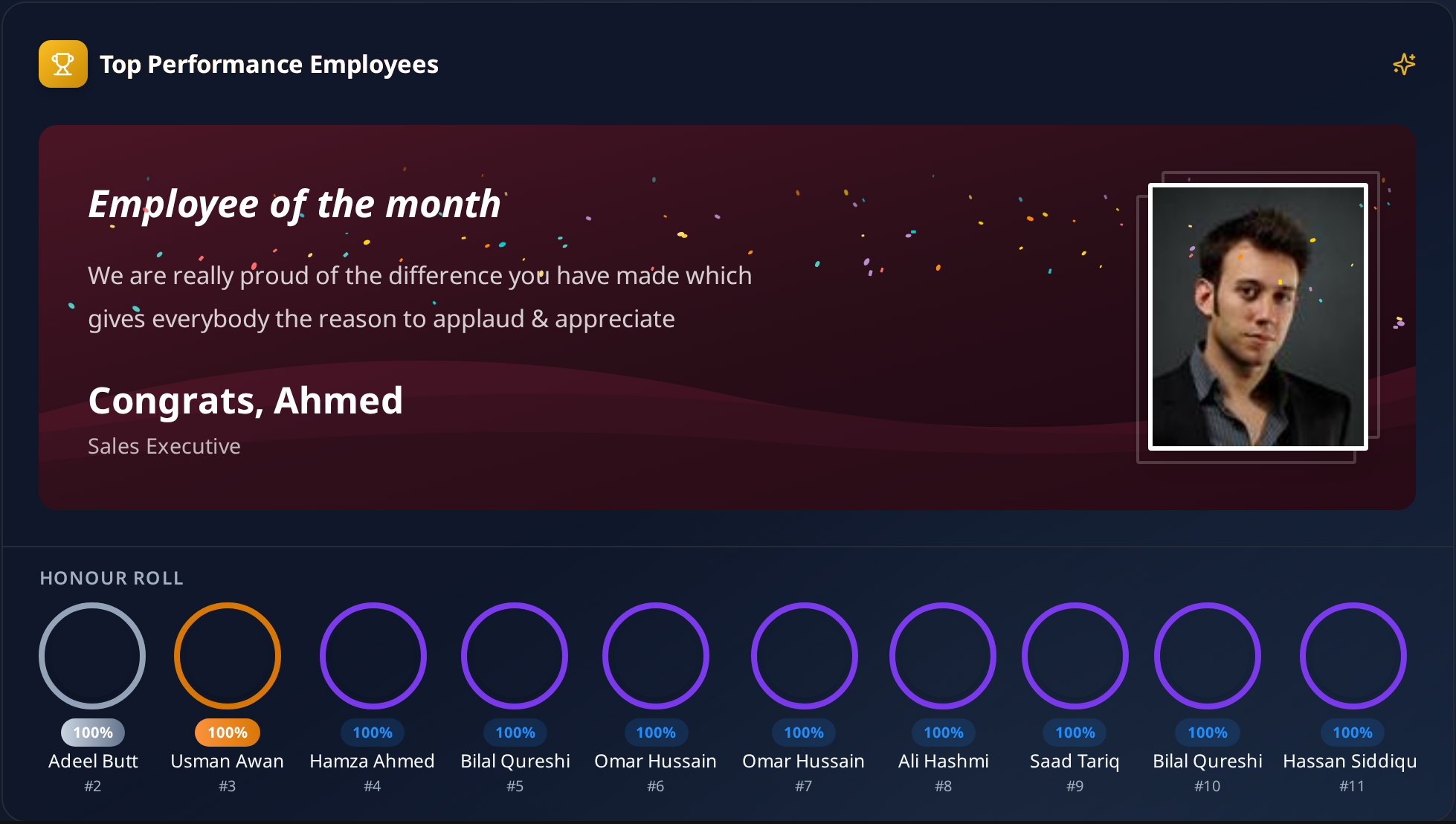
The cover image above (from the Zaffre HRM employee dashboard) is what the end state looks like: a deterministic leaderboard where every avatar earned its place via measurable inputs, not via being close to the right manager.
Step 1 — Move from nomination to inputs
The first move is the hardest: delete the nomination form. As long as a manager can write a free-text nominee, the program will skew toward people that manager interacts with most. Replace nomination with a list of inputs that get measured automatically every cycle:
- Attendance / on-time rate / productive hours
- KPI or OKR scores
- Anonymized 360° peer feedback
- HR-policy adherence (warnings, acknowledgements, clearance compliance)
The exact inputs depend on the company. The principle is constant: each input must be measurable without manager interpretation.
Step 2 — Lock the weights up-front, at the company level
Each input gets a weight — the percentage it contributes to the final score. Decide weights at the start of the cycle, at company level, before knowing who's leading. Locking weights early is what prevents post-hoc tilting (the most insidious bias path: nudging the formula toward a preferred candidate after the data lands).
A reasonable starting set for a typical knowledge-work company:
- Attendance: 20%
- KPI / OKR: 40%
- 360° peer feedback: 25%
- HR-policy adherence: 15%
A manufacturing company might invert KPI and Attendance. A creative agency might raise peer feedback. There's no universal right answer — only "decided up-front and applied uniformly".
Step 3 — Anonymize peer feedback with outlier dampening
360° peer feedback works when reviewers are anonymous and outliers don't dominate. Two specifics:
- Anonymous to the subject — the reviewed employee never sees who said what. Removes the "if I rate them low they'll know" pressure that distorts honest input.
- Outlier dampening — when one reviewer's score deviates 2+ standard deviations from the rest of the panel, the model down-weights that reviewer's contribution to the final aggregate. One bitter ex-teammate can't sink a candidate; one sycophantic friend can't lift one.
Step 4 — Publish the leaderboard, not just the winner
This is the step most HR programs skip and shouldn't. When only the winner is announced, the announcement triggers the question "why them and not me?" — and the absence of an answer corrodes trust. When the full leaderboard is visible (with score breakdowns), the program becomes a self-explaining ranking. Employees who didn't win see where they stood. They see what they need to improve. The next cycle's effort goes into the right places.
Zaffre HRM's TopPerformers widget (cover image above) shows this exact pattern — the Employee of the Month is the hero banner, and the Honour Roll below shows the runners-up. Every employee sees both.
Step 5 — Lock closed cycles + preserve the audit trail
Once a cycle is announced, freeze the data + weights. No post-hoc edits, no "let me just adjust the weights and re-run". The audit trail (source values, weights applied, final scores) is preserved indefinitely. Any employee who asks "why didn't I win?" gets a deterministic, defensible answer.
This single property — immutable closed cycles — is what turns EotM from a popularity contest into a fairness instrument. It's also what makes the program legally defensible if a discrimination claim is ever filed (the data shows you applied the same rule to everyone).
How Zaffre HRM bakes this in
The Evaluation module in Zaffre HRM implements all five steps as the default workflow:
- No nomination form anywhere in the UI. There is no "nominate a colleague" surface to accidentally re-create the favoritism path.
- Cycle setup screen where HR picks inputs + weights once. The next cycle inherits them unless explicitly changed (then snapshotted, so the change is auditable).
- Anonymized 360° flow with outlier dampening built into the aggregator (no configuration required).
- TopPerformers widget on the Employee dashboard surfaces the live leaderboard during the cycle, not just at announcement — so the cadence of "where do I stand?" is continuous, not a once-a-month surprise.
- Cycle close-out writes an immutable snapshot of all source data + weights to the audit log. Closed cycles cannot be edited from the UI.
Common objections + responses
"We tried metrics-based recognition before and it felt cold." — Usually that's because the metrics were 100% quantitative (just KPIs). The fix is to keep peer feedback in the mix; humans rating other humans, just anonymized. That preserves the human element while removing the favoritism channel.
"Managers will resist losing the nomination power." — Some will. The reframe is: "you keep nominating in your 1:1s and performance reviews, where it actually changes salary + promotion. The public award is just a leaderboard." Most managers accept this once they see they haven't lost real influence.
"What if a top performer gets snubbed by the algorithm because their work isn't on the dashboards?" — Either their work needs to be on the dashboards (in which case fix the dashboards), or the weights need to emphasize peer feedback over KPIs for that role. Both are explicit, both can be adjusted at the company level.