Merit-Based Employee Recognition Software — What to Look For
If you're shopping for "employee recognition software" in 2026, the search results will be 80% nomination-form products with a leaderboard glued on. Real merit-based recognition is rare because it requires the recognition module to be deeply integrated with the rest of the HRM — and most products bolt recognition on as a standalone surface that doesn't know what your employees actually did.
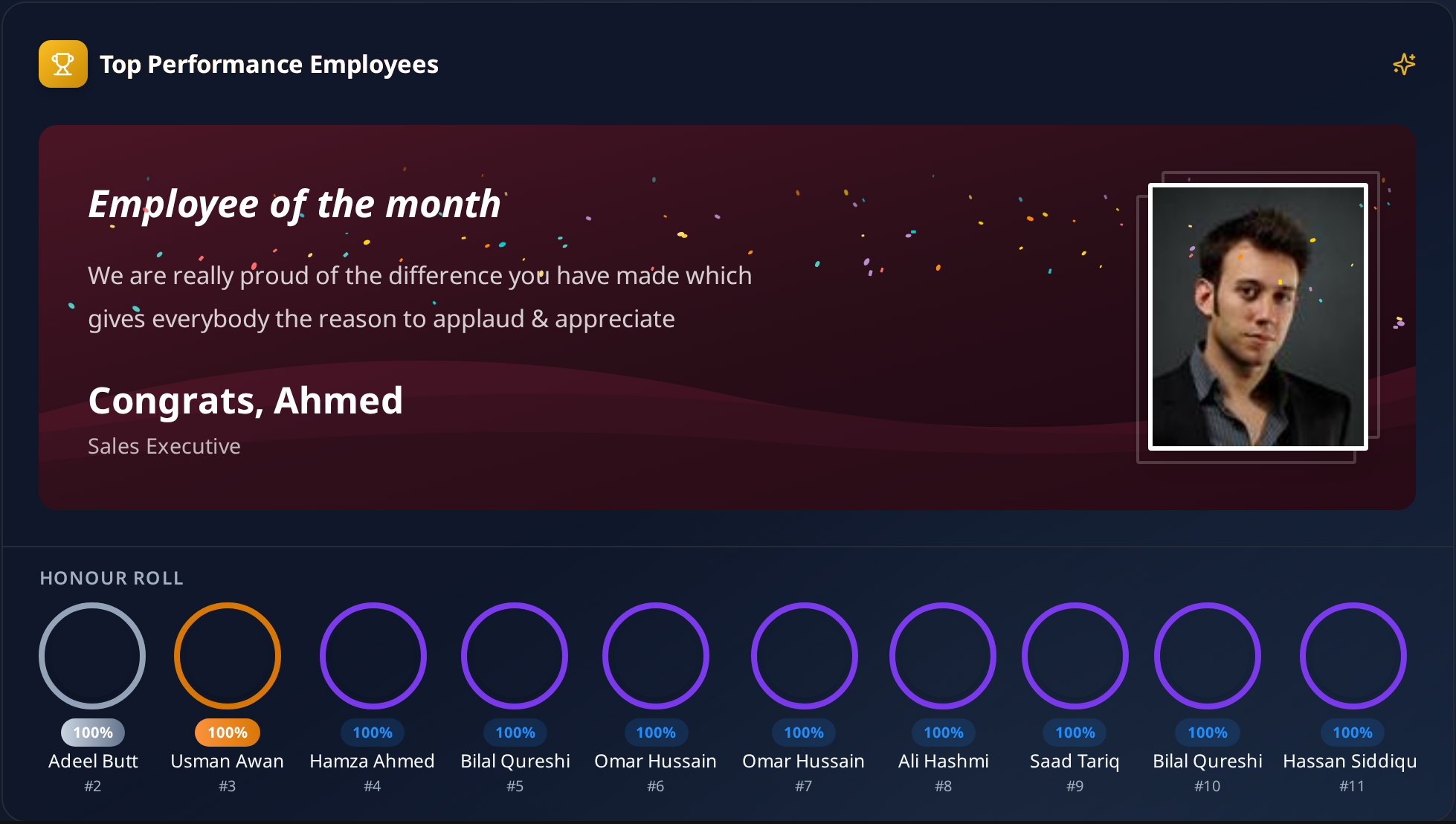
This guide is what to look for + what to ask. The cover image (from the Zaffre HRM dashboard) shows the end-state pattern: a deterministic leaderboard derived from measurable inputs.
The seven properties that separate merit-based from theatre
1. The recognition module reads from the same data layer as attendance, KPIs, and performance reviews
If recognition lives in a separate app — a Slack bot, a kudos board, a peer-shoutout feed — it cannot be merit-based. It can only be vibes-based. Merit-based recognition requires the module to read live attendance signals, KPI scores, and 360° peer reviews from the same source the rest of HR uses. Zaffre HRM's Evaluation engine reads directly from the attendance event log + KPI/OKR records + 360° feedback collected in-product — no cross-app sync to break.
2. No nomination form, anywhere
A "nominate a colleague" button is the cardinal anti-pattern. As soon as it exists, the recognition program drifts toward whoever is most-mentioned, not most-performant. Merit-based products don't have this button.
3. Configurable input weights, locked per cycle
The product must let HR decide what counts (attendance, KPIs, peer feedback, policy adherence) AND how much each counts. Once the cycle starts, the weights snapshot so they cannot be retroactively edited. Closed cycles are immutable.
4. 360° peer feedback with outlier dampening + anonymity
Peer feedback is essential — pure quantitative metrics miss roles where work is qualitative. But peer feedback only works when reviewers are anonymous AND outliers don't dominate. Both must be product properties, not honor-system properties. Zaffre HRM's 360° flow anonymizes reviewers to the subject + statistically dampens 2-sigma outliers automatically.
5. Live leaderboard visible to every employee, not just announcement-day surprise
The product should expose the leaderboard during the cycle, not only at the end. Employees should see where they rank week-to-week. The announcement at cycle end is then a confirmation of public knowledge, not a closed-door reveal that triggers "why them?" resentment.
6. Immutable audit trail
Every score component, every weight, every source-data point preserved indefinitely. If an employee asks "why didn't I win in Q2 2025?", HR should be able to pull the exact breakdown. This isn't a nice-to-have — it's what makes the program legally defensible.
7. The award surface is in the day-to-day HRM, not a separate site
Recognition that lives on a separate URL gets visited weekly. Recognition that lives on the dashboard the employee opens every day to mark attendance becomes culture. Zaffre HRM's TopPerformers widget (cover image above) sits on the Employee dashboard right above the attendance check-in — every employee sees it every working day.
Questions to ask vendors
- "Show me the screen where a manager nominates someone for Employee of the Month." — If they have one, the product is nomination-based. If they don't, ask how the winner is decided.
- "Walk me through the cycle setup. Where do I set the weights for attendance vs KPIs vs peer feedback?" — If weights aren't configurable, the algorithm is opaque + can't be defended.
- "After cycle close, can a manager edit a score?" — The correct answer is no.
- "Show me the full leaderboard view, not just the winner banner." — If the product only shows the top 1, the cycle becomes a black box.
- "How is peer feedback anonymized?" — If the subject can identify the reviewer, the input is distorted.
- "Show me the audit trail for a closed cycle from last year." — Live demo, not a slide.
- "What's the discrimination-claim defense path if an employee challenges the result?" — If the vendor can't answer, the product hasn't been tested under real legal pressure.
The Pakistan + Gulf market context
In the Pakistani and Gulf HRM market specifically, recognition programs are usually one of: (a) absent entirely, (b) a manager-nomination form bolted onto an HRM, or (c) a Slack / WhatsApp shoutout channel. None of these are merit-based. The local-market dynamics — denser social networks at work, more in-group bias along family + alma-mater lines, manager-centric culture — make favoritism worse here than in markets where recognition has been studied (US, EU).
Zaffre HRM was designed specifically against this baseline. The Evaluation engine + TopPerformers widget combination is intentionally the antidote.
Common gotchas
"Free" recognition products that need a paid HRM module to actually work. Read the fine print. A recognition Slack bot that reads from your HRM via integration is fine IF the integration is real-time AND the bot doesn't accept free-text nominations. Most don't pass both tests.
Products that promise "AI-powered recognition" without explaining the inputs. "AI" in recognition is usually just a wrapper around manager free-text nominations with sentiment analysis. That's not merit-based; that's nomination-based with extra steps.
Recognition programs sold as "engagement boosters" rather than "fairness instruments". Engagement is a downstream metric. The cause is fairness; the effect is engagement. Vendors who lead with engagement often skip the fairness mechanism entirely.
Where Zaffre HRM fits
Zaffre HRM is the merit-based recognition platform for Pakistan + Gulf HR teams who want the fairness mechanism to be a system property, not a manager's promise. The Evaluation engine reads from the same canonical employee record as attendance + payroll + performance — no integration drift. Weights are configurable + snapshotted per cycle. 360° peer feedback is anonymized + outlier-dampened. Closed cycles are immutable. The TopPerformers widget surfaces the live leaderboard daily.
See the bias-free recognition use case, book a demo, or read the deeper pieces below.