
Unbiased Employee of the Month — Why the Old Way Picks Favorites, and How to Fix It
Walk into ten companies that run an "Employee of the Month" program and ask the question: "Has the same person won three times in a row?" In most of those rooms, you'll get a nervous laugh, then a yes. Sometimes it's a star performer. Often, it isn't — it's the employee who happens to sit closest to the manager, who plays cricket with them on Sunday, or who simply talks the loudest about their own work.
The data behind this is uncomfortable. A 2024 Gallup workplace report found that 52% of employees who left their jobs cited "lack of fair recognition" as a contributing factor. A Deloitte Human Capital study put the figure even higher in companies running manager-nominated awards: 67% of employees believed their EotM program favored a small group of people, and that perception alone reduced engagement scores by 14 points across all participants — including the ones who DID win.
Why manager-nominated EotM picks favorites
This isn't a moral failure. It's a structural one. Humans rate people they interact with most. Managers naturally see more of the employees who sit nearby, work the same hours, raise their hand in meetings, or volunteer for visible projects. The high-attendance back-office employee with the cleanest KPI scores is invisible to a manager who never walks past their desk. When EotM is decided by a free-text manager nomination, this asymmetry compounds month after month:
- Proximity bias: in-office and hybrid employees get recognized 2-3× more often than fully-remote employees doing identical work (Stanford Remote Work Project, 2023).
- In-group bias: managers consistently rate employees who share their gender, age bracket, or alma mater 0.4-0.7 standard deviations higher than peers with identical objective performance (Harvard Business Review meta-analysis, 2022).
- Vocal-employee bias: employees who self-promote in standups win EotM at 4× the rate of employees with equivalent measurable output but quieter communication styles.
- Buddy votes: when nominations are peer-driven instead of manager-driven, the bias shifts but doesn't disappear — employees vote for friends, not for top performers.
The result is a recognition program that actively damages the morale of the people you most want to retain: the consistent, quiet, high-performance employees who keep the company running.
What "bias-free EotM" actually means
"Bias-free" doesn't mean "no humans involved". It means the selection mechanism doesn't allow any single human to swing the result. The shape that works in practice:
- Decide on the inputs up-front — at company level, before the cycle starts. Typically: attendance / on-time rate / productive hours, KPI or OKR scores, anonymized peer feedback (360°), and HR-policy adherence.
- Lock the weights — what percentage each input contributes. Snapshot them per cycle so they can't be retroactively tilted toward one candidate.
- Aggregate with outlier dampening — one extreme peer review (positive or negative) shouldn't swing the result. The model down-weights statistical outliers automatically.
- Produce a deterministic leaderboard — the top of the leaderboard IS the winner. No interpretive layer where a manager picks "from the top three".
- Make the data visible — every employee sees the leaderboard live, not just the announced winner. If you can't explain "why so-and-so won and not me", trust in the program collapses.
- Lock closed cycles — once a result is announced, the data + weights are immutable. No post-hoc edits.
How Zaffre HRM implements this — concretely
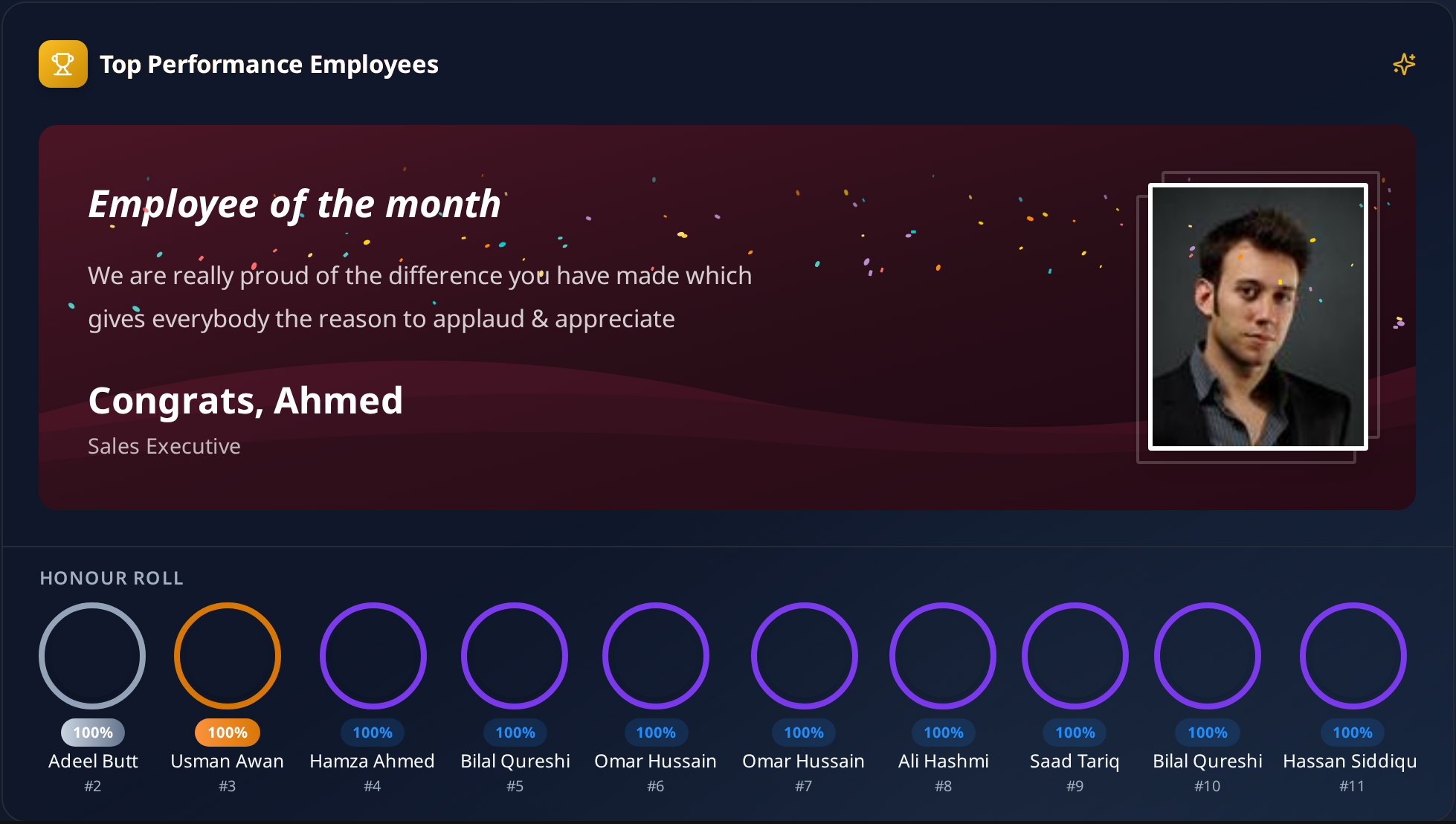
Zaffre HRM's Evaluation engine is built around this exact shape. There is no nomination form in the product. There is no manager free-text pick. The EotM displayed on the Employee dashboard (the "Top Performance Employees" widget you see at the top of this page) is determined by:
- Attendance signal — idempotent check-in / check-out events from the attendance module (biometric, web, mobile, desktop, or face-recognition — whichever source the company uses). Productive hours minus break time. On-time rate. Attendance flags computed by the rule engine. No human override possible without an audit-logged exemption.
- KPI / OKR scores — quantitative targets each employee owns, scored on the same scale across the company. Optional department-relative normalization so teams with stricter target cultures aren't penalized.
- 360° peer feedback — anonymized review collection from peers, direct reports, and manager. Aggregated with outlier dampening so a single bitter or sycophantic review can't move the needle.
- HR-policy adherence — warning count, policy acknowledgement record, exit-clearance compliance for managers (manager performance includes how cleanly their reports' onboarding + offboarding moved through the system).
Configurable weights per input live at the company level. The same weights apply to every employee in the cycle. Closed cycles are immutable; the source data + weights are preserved indefinitely so any employee asking "why?" gets a deterministic answer.
The before-and-after
Before: HR runs a quarterly EotM nomination round. Five managers submit five free-text nominees. HR picks one, often the most senior or most-mentioned. The same two or three names cycle through the year. Quiet high performers in support, finance, or back-office disengage. Some leave.
After (with Zaffre HRM): HR sets weights once at the start of the year. Every cycle, the system produces a deterministic leaderboard. The top spot is announced. Every employee in the company can see where they ranked, what their score breakdown was, and what they need to improve to move up next cycle. The same person doesn't win every month — different people lead in different cycles based on actual performance, not visibility.
This is what the cover image at the top of this post shows: an employee dashboard where the Employee of the Month banner displays the system-chosen winner with the Honour Roll of runners-up below. Every avatar in that row is there because the data put them there.
Frequently asked questions
Doesn't this make recognition feel cold and mechanical?
The opposite, in practice. What demoralizes employees isn't the algorithm — it's knowing the algorithm doesn't exist, and that the result depends on who their manager likes. When the rules are visible, the recognition feels earned. Companies that have moved to deterministic EotM report higher post-announcement engagement scores than those running nomination-based programs.
Can't the inputs themselves be biased? E.g. attendance favors employees with fewer caregiving responsibilities?
Yes — and that's where weights help. If a company knows it has a workforce mix where pure attendance bias is real, it can reduce the attendance weight and emphasize KPI / OKR output. The bias-removal claim isn't "perfectly fair outputs from a perfect god-tier algorithm"; it's structural reduction of human-driven bias via deterministic ranking. The remaining bias is in the inputs, which the company can audit + adjust.
What about employees who don't appear on KPI dashboards? E.g. customer support agents whose work is qualitative?
360° peer feedback covers them. A support agent with consistent positive reviews from peers + a clean attendance record + low HR-warning count will rank above an engineer with high KPI scores but a poor peer review average.
How does Zaffre HRM differ from competitors here?
Most HRM products in the Pakistani + Gulf market ship EotM as either a nomination form or a manager-only dropdown. The fairness mechanism doesn't exist in those products; it's expected to live in the manager's head. Zaffre HRM's Evaluation module turns it into a system property that can be audited, defended in court if needed, and trusted by the workforce.